
Strengthening the Club's leadership in integrated governance through:
Monitoring the ESG regulatory framework;
Integrating ESG principles into business operations.

Strengthening the Club's leadership in integrated governance through:
Monitoring the ESG regulatory framework;
Integrating ESG principles into business operations.

ESG (Environmental, Social, Governance) topics are becoming increasingly relevant on a global scale, accompanied by the constant evolution of the related regulatory framework. The objective of the strategic pillar "Sustainable Leadership" is to ensure full compliance with ESG regulations and to promote the integration of sustainability principles within the Company's governance structure and business model.
Juventus' governance structure adopts a traditional system that, in addition to the functions attributed to the Shareholders' Meeting, assigns strategic management to the Board of Directors (BoD) and supervisory functions to the Board of Statutory Auditors. Within the BoD, three advisory and propositional committees have been established: the Control and Risk Committee, the Nominations and Remuneration Committee, and the Environmental, Social, and Governance (ESG) Committee. The latter, instituted during the 2021/2022 season, consists of non-executive directors and plays a central role in integrating ESG themes into the company's activities.

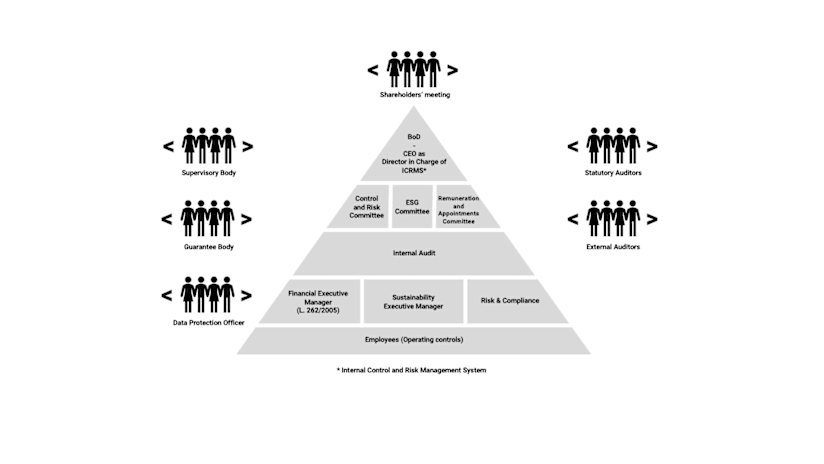
The ESG Committee supports the Board of Directors (BoD) in several key areas, including:
In addition to the ESG Committee, the Club established a Sustainability function in 2016, which has been integrated into the People, Culture & Sustainability Department as of July 1, 2023. This aims to foster a corporate culture rooted in sustainability principles. In line with the requirements of the National Licensing System, this function is complemented by the roles of:
Juventus has also implemented Diversity & Inclusion policies, promoting gender balance and the absence of discrimination within the Club. These principles are embedded in corporate regulations and procedures, such as the Code of Ethics and the Recruitment & Onboarding Procedure.
Since 2013, Juventus has been a pioneer in Italy and among the first in Europe to publish a sustainability report subjected to external review. Every year since, the Club has released increasingly detailed reports, standing out nationally. This ongoing effort ensures transparency and communication with stakeholders, highlighting challenges faced and goals achieved.
Starting from the 2024/2025 season, Juventus will comply with the Corporate Sustainability Reporting Directive (CSRD), further strengthening its commitment to sustainability.